
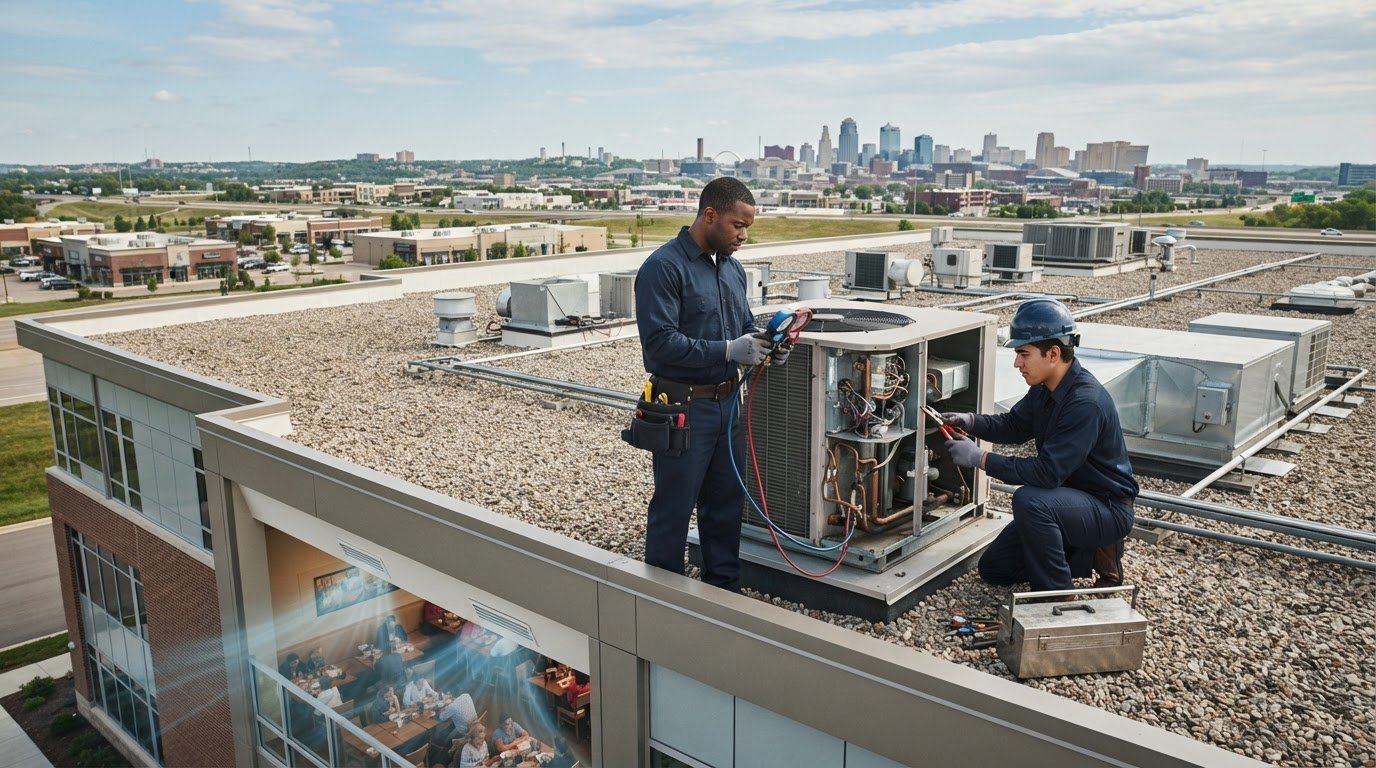
What if a cooling problem that seems limited to one room points to an issue elsewhere in the split system? A warm dining area, tenant space, or work area can disrupt daily operations. Commercial HVAC repair Kansas City businesses need starts with identifying what changed, where it changed, and which equipment serves the affected area.
Before arranging service, gather a clear picture of the issue. A commercial split system depends on indoor and outdoor equipment working together, so an airflow or control concern can affect performance beyond the first area where staff notice a problem. This guide explains the system’s main components, common operating symptoms, and useful details to record. It also covers how Supreme Mechanical Solutions supports commercial HVAC, refrigeration, and kitchen equipment across the Kansas City metro.
Key Takeaways
- Indoor and outdoor equipment work together in a commercial split system, while the thermostat signals the space’s temperature demand.
- Uneven conditioning, unusual sounds, or unexpected shutdowns are useful symptoms to record, not reasons to diagnose the equipment yourself.
- Before arranging service, note the affected area, symptoms, timing, and any access or operating constraints.
- Commercial HVAC repair Kansas City businesses need can cover split systems as well as rooftop units, mini splits, and VRF systems.
- Supreme Mechanical Solutions serves commercial buildings across the Kansas City metro, with related heating, refrigeration, and food equipment services.
What Is a Commercial Split System, and Where Does It Fit?
A commercial split system is an HVAC arrangement with indoor and outdoor equipment connected to operate as one system. The equipment sits in separate parts of the building rather than being housed together in a single package. Depending on its configuration, a split system can provide cooling, heating, or both.
For building operators, “split” describes how the equipment is arranged. It does not tell you whether the system is the right fit for every space. A restaurant, office, or other commercial building may have different demands across rooms and operating hours. Building layout, how each area is used, and the installed equipment configuration all shape system requirements.
This context helps when arranging commercial HVAC repair Kansas City service. Identifying the equipment type gives the service team a useful starting point, but it does not reveal the cause of a performance change. The equipment and building conditions need to be assessed together.
Which commercial spaces may use split systems?
Commercial split systems may be used in offices, restaurants, and other commercial spaces. In a building with distinct areas, separate indoor zones can support different space requirements. For example, a dining area and an office may have different occupancy patterns or comfort demands.
Not every split system controls every room independently. The number and layout of indoor zones depend on the installed configuration. When assessing a system or describing a service concern, note which areas it serves and how those areas are used. That information helps connect the equipment to the building’s day-to-day operating needs.
How split systems differ from rooftop units
A split system separates indoor and outdoor equipment. A rooftop unit is a distinct commercial HVAC equipment category, commonly arranged as a packaged unit on the roof. Both can serve commercial heating or cooling needs, but their equipment locations and configurations differ.
Those differences affect how equipment fits a building and how service is approached. Before scheduling a repair, identify whether the affected equipment is a split system or rooftop unit, if you know. The commercial rooftop units guide covers that equipment category and its operating considerations.
Neither equipment type is a universal fit. Building design, space requirements, and system configuration all matter. For restaurants and other businesses, knowing the difference helps keep the service conversation focused on the installed equipment and the areas it serves. It also gives facility teams a useful starting point when documenting an issue or planning future HVAC work.
How Commercial Split System Components Work Together
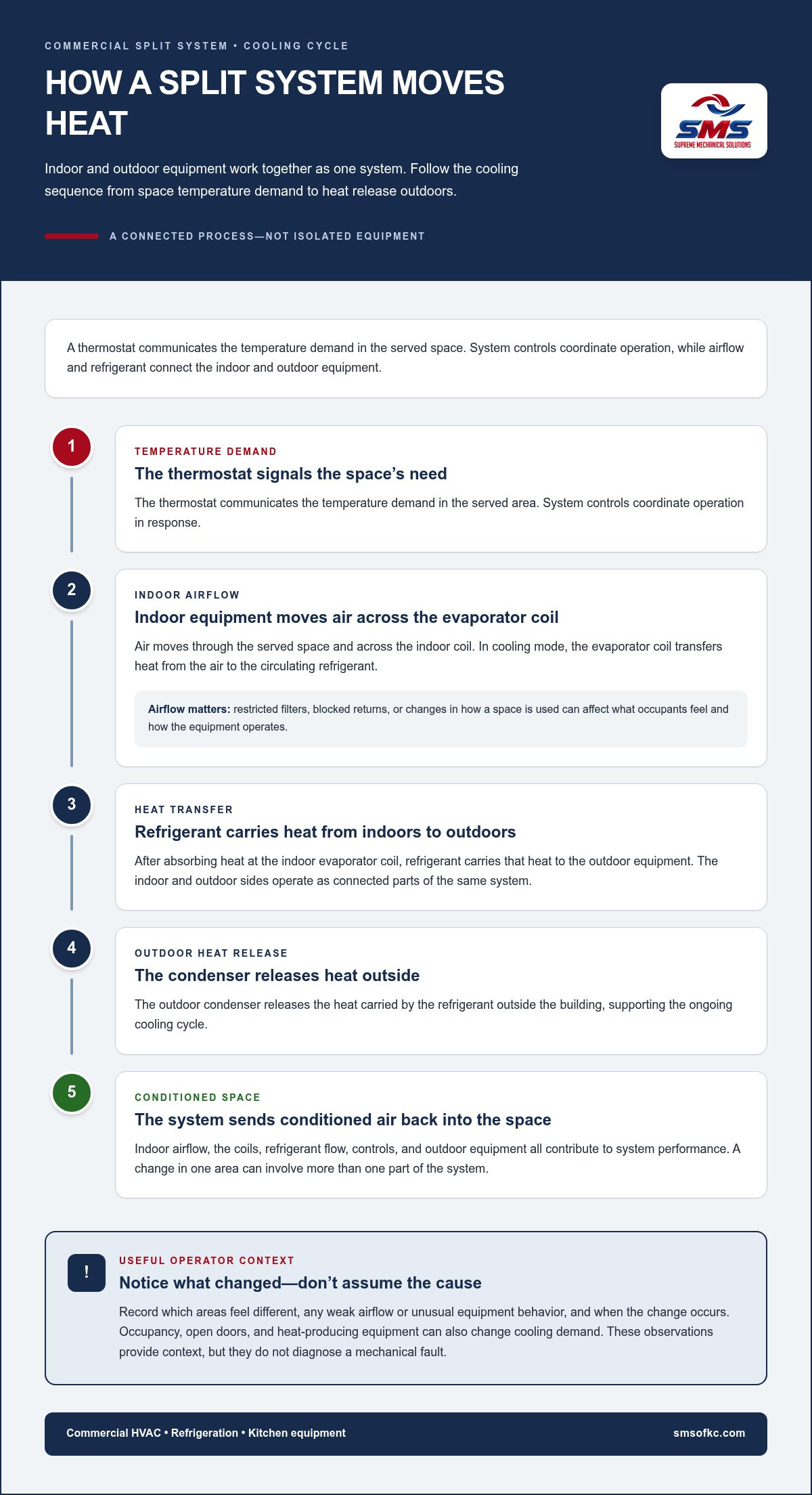
A commercial split system operates as one coordinated unit, even though its indoor and outdoor equipment are in different locations. The thermostat communicates the temperature demand in the served space, and the system controls coordinate operation in response. A change in one area, such as weak airflow or a room that is not reaching its set temperature, can involve more than one part of the system.
The indoor equipment conditions air in the served space, while the outdoor equipment supports the system’s heat-transfer process. In cooling mode, refrigerant circulates between the two sides and carries heat from indoors to outdoors. The thermostat, airflow path, coils, and outdoor equipment all contribute to system performance.
At the indoor evaporator coil, refrigerant absorbs heat from the air. It carries that heat to the outdoor equipment, where the condenser releases it outside. Because the cycle depends on connected components working together, commercial HVAC repair Kansas City service should consider how the full system operates instead of assuming the first visible symptom identifies the failed part.
What the indoor equipment does
Indoor equipment moves air through the served space and across the evaporator coil. During cooling, the coil transfers heat from the air to the circulating refrigerant, and the system sends conditioned air back into the space. Airflow matters: restricted filters, blocked returns, or changes in how a space is used can affect what occupants feel and how the equipment operates.
What the outdoor equipment does
During cooling, the outdoor equipment works with the indoor components to move heat out of the building. Its condenser releases heat carried by the refrigerant, supporting the ongoing cycle. The outdoor section does not operate as a separate solution to an indoor comfort issue. Refrigerant flow, controls, and indoor airflow connect its operation to the rest of the system.
Conditions in the space also provide useful context. Occupancy, open doors, and heat-producing equipment can change cooling demand in a commercial area. These factors do not diagnose a mechanical fault, but they can help explain when a change occurs and which spaces are affected. Consider thermostat readings, warm areas, and unusual equipment behavior alongside the system’s overall operation.
For example, if one zone feels different while another remains comfortable, that observation can help focus the service conversation. It does not prove that the thermostat or a particular coil is at fault. A technician evaluates the connected system and building conditions before determining what needs attention. Supreme Mechanical Solutions services commercial split systems in the Kansas City metro. To arrange commercial HVAC service, share what you have observed and which areas are affected.
Commercial Split System Problems: Symptoms Operators Should Notice
Changes in comfort or equipment operation are worth documenting, especially if they return after seeming to resolve. A split system serves specific areas, so note where staff or tenants first notice a difference and whether other zones are affected. Clear observations help the service team understand the concern without requiring operators to diagnose mechanical components.
Symptoms identify a service concern, not its confirmed cause. Uneven cooling, a new operating sound, or a shutdown can have different causes. A technician needs to assess the equipment and operating conditions to determine what is happening.
Changes in comfort, airflow, or operation
Pay attention to what has changed from normal operation. Air may feel weaker at some outlets, one room may feel warmer than nearby areas, or the system may make an unfamiliar sound or stop unexpectedly. Note the specific rooms or zones involved, when the change began, and whether it happens consistently or only under certain operating conditions.
Keep the record factual. For example, write “the back office feels warmer in the afternoon” rather than concluding that a particular component has failed. If the issue comes and goes, note when it occurs and whether the equipment was operating at the time. Recurring patterns can help a technician evaluate the system, but they do not confirm a diagnosis on their own.
When a cooling issue affects business operations
A comfort concern can become an operational problem if it affects staff, customers, tenants, or equipment in a space. Note whether the condition is worsening, limiting how an area is used, or disrupting normal business activity. In a restaurant, for instance, identify which occupied areas are affected and whether the issue changes during service. Include the practical impact along with the equipment symptoms.
If a commercial HVAC issue is urgent, call Supreme Mechanical Solutions’ 24-hour emergency service at (913) 399-7711. Explain what has changed, which spaces are affected, and how the issue is affecting operations. This gives the service team useful context while leaving diagnosis to the technician.
For routine commercial HVAC repair Kansas City businesses can prepare a concise record before arranging service. Include:
- The rooms or zones where conditions changed.
- The observable symptom, such as uneven conditioning, an unusual sound, or a shutdown.
- When the issue began and whether it repeats or varies.
- Whether the problem is worsening or affecting normal operations.
These notes help distinguish a one-time observation from a recurring pattern. They also give operators a practical way to communicate what they have seen without guessing at the cause. If conditions change before service is arranged, update the record so it reflects the current situation.
What to Document Before Scheduling Commercial Split System Service
A clear service request starts with what your team can observe. You do not need to identify a failed part. Record the affected area, describe the change, and note when it happens. Share those details when arranging service to give the conversation a practical starting point.
Build a useful symptom record
Keep the notes brief and specific. Identify the room or zone, describe what feels or sounds different, and note when the condition first appeared. Record whether it is continuous, intermittent, or recurring at a particular point in the operating day. If several areas are affected, list them separately so the pattern is clear.
Include relevant changes in building use, such as a shift in occupancy or equipment operating schedule. These details may help put the symptom in context, but avoid guessing at a mechanical cause. For example, write “the front office is warmer after lunch” rather than naming a component you suspect is at fault. Observations help focus commercial HVAC repair Kansas City service discussions, while a technician determines the cause.
Prepare the site and service details
Before scheduling, identify where the indoor and outdoor equipment is located and share any access considerations. Note building operating needs that may affect coordination, such as busy periods or areas that need to remain accessible. Explain how the issue affects staff, tenants, customers, or normal use of the space, and whether the condition has changed since it began.
If you have relevant system history, such as prior service or installation information, keep it available. The commercial air conditioning installation guide can provide useful background when reviewing system context and project history. Share what you know, but do not delay arranging service while searching for records.
Use this sequence to prepare a concise request:
- Identify the affected room, zone, or area.
- Describe the observable change, including any unusual sound or shutdown.
- Note when it started and whether it is continuous, intermittent, or recurring.
- Share relevant operating conditions, access details, and business impacts.
- Arrange service and update the team if symptoms change.
For an urgent commercial HVAC concern, call Supreme Mechanical Solutions’ 24-hour emergency service at (913) 399-7711. Clear, current information helps the team understand the operating impact and prepare for the service conversation. It does not replace an on-site assessment, but it can keep the initial discussion focused on the affected system and business needs.
For commercial split system service in the Kansas City metro, Call (913) 399-7711 or email sales@smsofkc.com to schedule service.
Commercial Split System Service in Kansas City: What Supreme Mechanical Solutions Handles
Supreme Mechanical Solutions provides commercial split system service across the Kansas City metro in Kansas and Missouri. The company serves restaurant owners, franchise operators, property managers, and facility teams with commercial building equipment. Share the system type, affected areas, and observed changes when arranging service so the conversation starts with useful site context.
Split systems are one part of the company’s commercial air conditioning work. Supreme Mechanical Solutions also services rooftop units, mini splits, and VRF systems. These equipment categories have different arrangements and operating considerations, so identifying what is installed helps keep the service request specific. A technician assesses the equipment and conditions to determine what attention is needed.
Commercial buildings and related systems
Restaurants, gas stations, warehouses, and other commercial buildings rely on multiple systems to support daily operations. In a restaurant, for example, HVAC, refrigeration, and cooking equipment needs can arise during the same workday. A comfort concern may affect staff or customers, while a separate refrigeration or food equipment issue may also need attention.
Supreme Mechanical Solutions handles commercial refrigeration service and commercial cooking and food equipment repair alongside HVAC work. The company also services exhaust fans and makeup air units. For a facility manager coordinating multiple concerns, related services can simplify communication and help organize work across the building’s systems.
Be specific about which equipment is affected. A split system concern, a walk-in cooler issue, and a kitchen equipment problem require distinct service attention, even if they occur in the same operation. Sharing each symptom and its business impact helps the team understand the scope of the request. It does not replace a technician’s assessment, but it gives the service conversation a useful starting point.
Supreme Mechanical Solutions serves commercial customers in Kansas City, Kansas City MO, Kansas City KS, Overland Park, Olathe, Lenexa, Shawnee, Leawood, Lee’s Summit, Independence, Blue Springs, Liberty, Gladstone, Grandview, Belton, Raymore, and Louisburg.
Schedule service with Supreme Mechanical Solutions
For planned service coordination, the office is open Monday-Friday, 8:00 AM-4:30 PM. Share the building location, equipment involved, affected area, and any access or operating constraints. This information helps organize the request around your commercial site and its needs.
For commercial split system service and related HVAC, refrigeration, or kitchen equipment needs, Call (913) 399-7711 or email sales@smsofkc.com to schedule service.
Turn Service Findings Into a More Useful Plan
Once a technician has assessed the equipment, use the findings to guide your next facilities conversation. A clear record of the service issue and its operational impact can help your team track recurring concerns and coordinate future planning across building systems. That is especially useful for businesses where HVAC, refrigeration, and food equipment support daily operations.
For commercial HVAC repair Kansas City businesses can rely on, coordinate directly with a commercial service team. Supreme Mechanical Solutions provides commercial split system service and related support for HVAC, refrigeration, and food equipment across the Kansas City metro in Kansas and Missouri.
Bring your service notes and relevant site or operating details to the conversation. A practical, well-informed starting point keeps attention on your building’s needs and the work ahead. Call (913) 399-7711 or email sales@smsofkc.com to schedule service.
Frequently Asked Questions
What is a commercial split system?
A commercial split system is an HVAC arrangement that connects indoor and outdoor equipment to serve a commercial space. The configuration can vary with the building and its operating needs. Knowing whether the installed equipment is a split system helps facility staff distinguish it from other HVAC categories when reviewing site records or describing a service concern. That identification is useful context, but it does not establish what caused a performance change.
How does a commercial split system work?
A commercial split system uses connected equipment and controls to respond to conditions in the served space. During cooling, refrigerant carries heat from the indoor section to the outdoor section. Airflow also matters. If one area feels different from others, note where and when the change occurs. Those details describe the system’s behavior, while a technician evaluates how the equipment and controls are functioning together.
Is a commercial split system different from a rooftop unit?
Yes. A split system separates its indoor and outdoor equipment, while a rooftop unit is a separate commercial HVAC equipment category arranged as a packaged unit on the roof. The difference is useful to note when reporting an issue, especially in buildings with more than one type of HVAC equipment. Naming the affected system and area helps keep the service request focused on the right equipment.
What are common signs a commercial split system needs service?
Possible warning signs include uneven comfort between areas, reduced airflow, an unfamiliar operating sound, or equipment shutting down unexpectedly. Notice whether the change affects one room or multiple areas, and whether it comes and goes or remains consistent. A schedule change or different use of a space may also be useful context. Symptoms signal a concern, but they do not confirm which component needs attention.
Can a commercial split system serve multiple areas?
Yes, some commercial split system configurations serve separate indoor areas or zones. The arrangement depends on the equipment, so the number of spaces served and how they are controlled can vary. If conditions differ between rooms, record which areas are affected and whether they change at the same time. This gives a technician a clearer picture of the building’s comfort pattern without assuming every zone operates independently.
What should I tell a commercial HVAC technician about a split system problem?
Describe the affected area, the change you have observed, and when it started. Include whether it is continuous, intermittent, or recurring, along with any relevant changes in building use or operating schedule. Mention equipment location and access considerations, too. For commercial HVAC repair Kansas City service, these practical details help focus the initial conversation on the system and business impact without asking you to identify the mechanical cause.
Does Supreme Mechanical Solutions provide emergency commercial HVAC service in Kansas City?
Yes. Supreme Mechanical Solutions provides 24-hour emergency commercial HVAC service for businesses in the Kansas City metro. For an urgent concern, share the equipment type, affected area, and practical impact on operations. Those details help clarify the service request without asking staff to diagnose the system. Call (913) 399-7711 or email sales@smsofkc.com to schedule service.


