
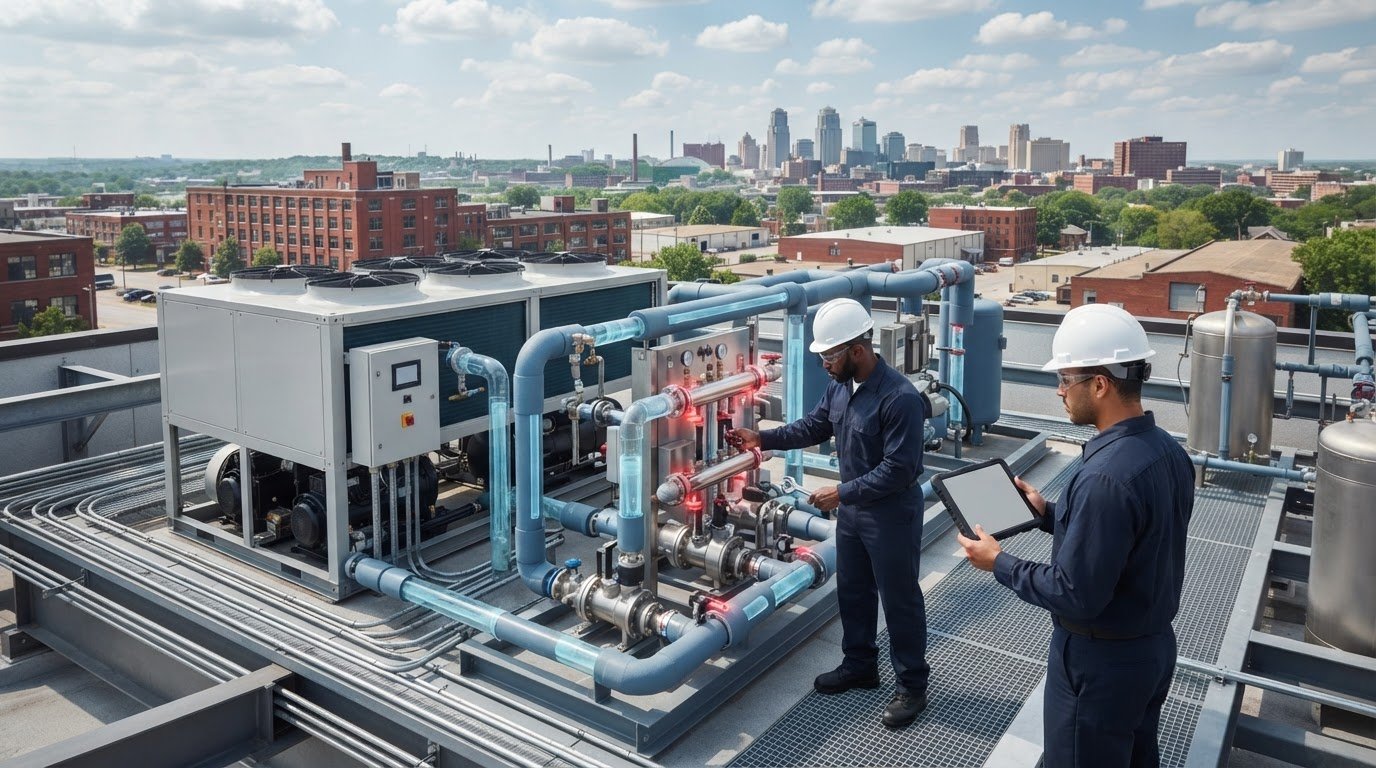
A chiller’s value depends on more than how cold it can make fluid. Commercial glycol chillers cool a glycol-water mixture and circulate it through a closed loop to remove heat from connected equipment or processes. Both the mixture and the flow rate affect system performance.
For a restaurant or facility, dependable cooling takes more than choosing a chiller by capacity. Glycol concentration, circulation, heat load, and maintenance all affect daily operation. Understanding these factors helps you plan a system around the equipment it serves.
This guide explains how glycol chillers work, how mixture strength and flow affect closed-loop cooling, and what to consider when sizing and maintaining a system. It also covers practical trade-offs: glycol supports low-temperature operation but adds considerations for circulation and upkeep. Use these points to assess your cooling requirements and identify when commercial refrigeration service can help.
Key Takeaways
- Match chiller capacity and fluid flow to the system’s cooling load and layout, not just a model label.
- Choose glycol concentration with the required freeze protection in mind; mixture strength also affects circulation.
- Weigh the operating benefits of a closed loop against the added fluid and maintenance considerations.
- Build routine checks of fluid condition, flow, pressure, coils, pumps, and refrigerant into maintenance planning.
- Use the article’s planning factors to identify when a commercial refrigeration specialist can help assess the system.
Outdoor chiller model capacities and flow rates
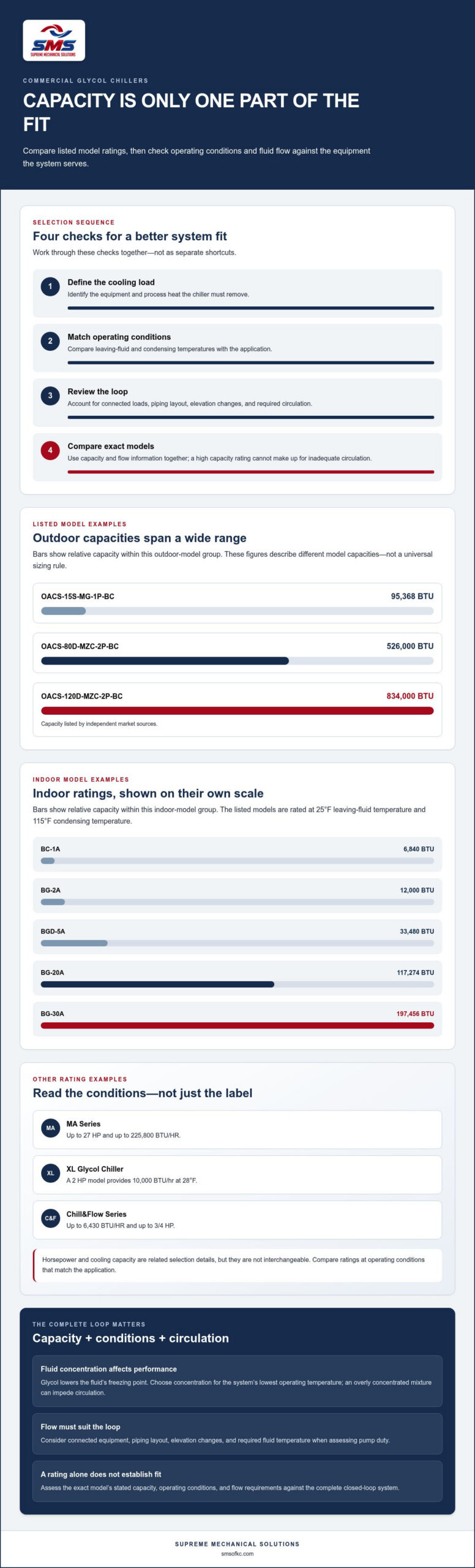
Outdoor glycol chillers vary widely in cooling capacity, so compare the unit’s rating with the system’s actual heat load. For example, the outdoor OACS-15S-MG-1P-BC is listed at 95,368 BTU, while the OACS-80D-MZC-2P-BC is listed at 526,000 BTU. Independent market sources list the outdoor OACS-120D-MZC-2P-BC glycol chiller with a capacity of 834,000 BTU. These figures describe different model capacities, not a universal sizing rule.
Horsepower and cooling capacity are related selection details, but they aren’t interchangeable labels. The MA Series reaches up to 27 HP and up to 225,800 BTU/HR. A 2 HP XL Glycol Chiller provides 10,000 BTU/hr at 28°F. Compare each rating at the operating conditions that match the application. A capacity figure without its temperature conditions may not reflect the load the chiller must handle.
Indoor models also span different capacities. The BC-1A is listed at 6,840 BTU, while the BG-2A is listed at 12,000 BTU. Larger examples include the BGD-5A at 33,480 BTU, BG-20A at 117,274 BTU, and BG-30A at 197,456 BTU. These listed indoor models are rated at 25°F leaving fluid temperature and 115°F condensing temperature. Compare those conditions before using ratings to assess fit.
Series names alone don’t establish a suitable capacity. The Chill&Flow Series reaches up to 6,430 BTU/HR and up to 3/4 HP. For a ChilStar Series selection, assess the exact model’s stated cooling capacity and its rated operating conditions. Don’t infer a unit’s output from its series name or horsepower alone.
Flow rate matters because the pump must move cooled fluid through the loop and return it to the chiller. A high capacity rating cannot make up for inadequate circulation. When assessing flow, consider connected equipment, piping layout, elevation changes, and required fluid temperature. These factors affect resistance in the loop and help determine the pump duty required.
- Define the load: identify the equipment and process heat the system must remove.
- Match operating conditions: compare leaving-fluid and condensing temperatures with the application.
- Review the loop: account for piping, connected loads, and required circulation.
- Compare exact models: use capacity and flow information together, not as separate selection shortcuts.
For outdoor installations, consider the chiller’s location and the airflow around it. The selected model’s capacity, operating temperatures, and flow requirements should suit the complete closed-loop system.
What Is a Glycol Chiller?
A glycol chiller uses refrigeration to cool fluid circulating through a closed loop. The loop carries heat away from connected equipment and returns the warmed fluid to the chiller.
Commercial glycol chillers may be rented, leased, or purchased, depending on how long the equipment is needed and how the business plans to manage it. Renting or leasing may suit temporary demand, while buying may fit ongoing operation. Compare ownership responsibilities and costs over the expected period of use.
Permit requirements depend on the installation location and project scope. Electrical needs are determined by the selected equipment’s nameplate and system design. Refrigerant requirements depend on the equipment and applicable rules.
Purchase and installation costs depend on the project and are established through a quote. Factors include capacity, site conditions, piping, electrical work, and commissioning.
Commercial and Industrial Applications
Commercial and industrial processes often need controlled cooling through a separate fluid loop. A warehouse process, production line, or commercial kitchen may have its own operating schedule and equipment load. Identify the process, connected equipment, and cooling requirements before planning the system.
Plan application support around the chiller, pump, piping, and connected loads as one system. For example, facility staff can document when a production process runs, which equipment needs cooling, and how the loop reaches it. These details clarify system requirements and provide useful context for maintenance and troubleshooting.
Food and Beverage Applications
Breweries use glycol loops to transfer cooling from a chiller to process equipment, including fermentation vessels. When planning a new or changed process, account for the equipment, operating patterns, and cooling demand. The circulating fluid carries heat from the process back to the chiller.
Food and beverage operations can also use a dedicated fluid loop to cool process equipment. Map the route from the chiller to each load, including how branches distribute fluid. In beverage service, for example, the trunkline layout and connected lines affect how cooling reaches the equipment.
When planning commercial glycol chillers, start by recording the equipment served and its operating schedule. Keep system information accessible to facility staff and service technicians. If a process changes or new equipment joins the loop, update the records so future service reflects the current setup.
Glycol-water mixtures in closed-loop cooling systems
A closed-loop cooling system circulates a glycol-water mixture between the chiller and connected equipment. Water freezes at 32°F, and adding glycol lowers the process fluid’s freezing point. The needed concentration depends on the system’s lowest operating temperature and the fluid requirements of its equipment.
Choose a glycol formulation intended for the application, and follow its product label and equipment requirements. Do not assume different fluids can be mixed or substituted. The key operating risk is a concentration that fails to provide the required freeze protection. An overly concentrated mixture can also impede circulation, so balance protection with the loop’s flow requirements.
For brewing, the listed mixing examples provide practical reference points: 1 gallon of glycol with 1.5 gallons of water makes a 40% glycol mix; 1 gallon of glycol with 1.75 gallons of water makes a 36.3% mix. These examples show how changing the water proportion changes the mixture. Select the concentration for the operating conditions, rather than copying a recipe without considering the system.
In a brewery, the loop may serve fermentation tanks, brite tanks, and wort cooling equipment. Each load has its own cooling demand and operating pattern. A 60-barrel fermentation tank can contain 1,890 gallons of beer, so the system plan should account for the connected tank volume and process requirements. Glycol carries heat from the equipment back to the chiller for removal.
A piping drawing makes the loop easier to understand before installation or service. Show the chiller, pump, supply and return lines, branches, valves, and each connected tank or heat exchanger. Label the flow direction and identify which branches serve fermentation, brite tanks, or wort cooling. This gives operators and technicians a shared map for tracing flow and isolating a branch during maintenance.
Check the fluid temperature and return conditions against the system’s needs. Glycol returning to the chiller should not exceed 100°F. If return fluid runs hotter, review the process load, heat transfer, and circulation path. A brewing system with multiple tanks may have changing demand as fermentation stages shift, so the drawing should reflect actual connections and operating modes.
- Document the mixture: record the glycol formulation and concentration used.
- Map every load: identify each tank, wort circuit, and return path.
- Track return conditions: compare fluid temperature with the 100°F limit.
- Review changes: update piping drawings when equipment or branches change.
These steps bring fluid selection, fermentation cooling, and piping layout together in one operating plan. A clear drawing and recorded mixture make it easier to assess whether the glycol loop suits the brewing process.
Advantages and disadvantages of glycol systems
Glycol systems allow commercial refrigeration equipment to serve loads beyond the chiller itself. A brewery can circulate chilled fluid to process equipment, while a food facility can use a separate loop for a remote cooling load. Multiple loads can connect to one system, provided its capacity and piping layout can support them.
Energy use depends on the chiller’s cooling load, operating hours, pump demand, and outdoor conditions. Compare the electricity used by the chiller and pump with the cooling delivered during normal operation. For example, debris on a condenser coil can restrict heat rejection and affect performance, so inspection and cleaning belong in efficiency planning.
A glycol loop provides freeze protection where water alone could freeze under the required operating conditions. The circulating fluid can transfer cooling between a central chiller and equipment at different points in a building. For example, a process line can receive cooling without a separate refrigeration unit at each load.
The trade-off is that glycol changes how the fluid behaves. Compared with water, a glycol mixture is more viscous and transfers heat less effectively under equivalent conditions. As concentration rises, the pump may need to work harder to move fluid through the same piping. This can increase electrical demand and reduce cooling at a process load.
- Operational benefit: one loop can serve several connected loads.
- Design trade-off: fluid concentration affects pumping and heat transfer.
- Maintenance consideration: fluid condition, pumps, and heat-transfer surfaces need attention.
System layout matters as much as the chiller. A long, narrow branch serving a remote heat exchanger can have different flow conditions from a short branch near the pump. Where the design allows, isolation valves let technicians work on one section while other connected loads remain available. Clear pipe labels also help staff trace supply and return lines during service.
Glycol systems require planned handling and monitoring. A leak can lower fluid volume and disrupt circulation, while fluid condition can change over time. Keep service records that identify the mixture, fluid additions, and repairs. If the facility has several loads, record which equipment each branch serves. These details help technicians distinguish a chiller issue from a local flow restriction.
Weigh the advantages against the specific operating need. A glycol loop is useful when freeze protection or remote fluid cooling supports the process. Direct refrigeration may be simpler when loads are close together and do not need that protection. For a commercial kitchen walk-in cooler installation in Lee’s Summit or production space, consider system complexity, pump energy, maintenance access, and cooling demand before choosing an arrangement.
Glycol chiller maintenance
Maintenance helps protect cooling performance by keeping the fluid, condenser, and circulation components in working condition. Set a frequency for each check and record the results. For commercial glycol chillers, the core routine covers glycol concentration and pH, flow and pressure, condenser coils, pump seals, and refrigerant charge.
Check glycol concentration and pH monthly. Record each reading and compare it with the system’s operating requirements. Changes can affect freeze protection and fluid condition. Check flow rate and pressure monthly, too. Compare readings with previous records and investigate changes before they affect cooling at connected equipment.
Clean condenser coils quarterly. Dust and debris restrict heat transfer, making the condenser work harder to reject heat. Cleaning the condenser alone can improve chiller efficiency by 10-15%. Keep the surrounding area clear so air can move through the coil. In a brewery, note whether cooling performance changes after cleaning.
- Monthly: check glycol concentration, pH, flow rate, and pressure.
- Quarterly: clean condenser coils and record their condition.
- Annually: inspect pump seals and replace them as needed.
- Yearly: verify the refrigerant charge.
Inspect pump seals annually. Look for leakage around the pump and note any changes in circulation. A seal problem can cause fluid loss and reduced flow. Record the inspection and any replacement in the equipment log to help staff connect later changes in flow or pressure with completed service.
A qualified refrigeration technician should verify refrigerant charge yearly. Charge affects the chiller’s ability to move heat, so record service findings with the equipment history. Do not assume a temperature complaint proves there is a refrigerant issue. Flow restrictions, condenser condition, fluid concentration, and process load can also affect cooling.
Consistent records help distinguish gradual change from a sudden fault. Log the date, concentration, pH, flow, pressure, coil condition, and corrective work. If a brewery adds a tank or changes its process schedule, note the change alongside operating observations. Technicians can then compare system condition with workload and service history.
With proper maintenance, glycol chillers typically last 15-20 years. A scheduled preventive maintenance plan can organize these recurring checks and document service across the equipment’s life. Use the checklist to assign responsibilities, track findings, and address developing issues before they interrupt cooling.
Supreme Mechanical Solutions: Air Conditioning
Supreme Mechanical Solutions supports commercial buildings with air conditioning for occupant comfort alongside process cooling. Its commercial systems include rooftop units, split systems, and mini split systems.
When planning or servicing a facility’s comfort-cooling equipment, consider the building layout and existing system. A rooftop unit suits a different configuration than a split system, so matching equipment to the space matters. Glycol process cooling and building air conditioning serve distinct needs.
For commercial air conditioning in the Kansas City metro, explore available system support. Contact Supreme Mechanical Solutions to discuss your facility’s air-conditioning needs.
Plan the Next Step for Your Cooling System
Turn your cooling requirements into an operating plan your facility team can use. Identify the equipment served, expected operating patterns, and who will track system changes. This gives future maintenance and upgrade decisions a practical reference instead of relying on assumptions during a disruption.
When planning commercial glycol chillers, consider how process cooling fits alongside building comfort needs. Clarify system responsibilities, document changes to connected equipment, and ensure the people responsible for operations can access current system information. A coordinated plan helps your team set priorities with its mechanical service partner.
Supreme Mechanical Solutions provides commercial air conditioning, including rooftop units and split systems. For Kansas City-area operators, the company can support building comfort needs as you plan cooling for commercial operations. Discuss your facility’s priorities with Supreme Mechanical Solutions to identify a practical next step.
A clear plan puts your team in a stronger position to manage dependable day-to-day operations.
Frequently Asked Questions
What are commercial glycol chillers and how do they work?
A refrigeration cycle cools the circulating glycol-water solution. A pump moves fluid through a loop serving process equipment, then returns the warmed fluid to the chiller. For example, a heat exchanger can transfer heat from production equipment without placing the chiller beside it. This arrangement suits facilities where cooling must travel from a central unit to separate loads.
What industries and applications use commercial glycol chillers?
Breweries use glycol loops for fermentation and other temperature-controlled processes. Commercial and industrial facilities may also need circulating process cooling. For businesses in Kansas City, Kansas City, MO, Kansas City, KS, Overland Park, Olathe, Lenexa, Shawnee, Leawood, Lee’s Summit, Independence, Blue Springs, Liberty, Gladstone, Grandview, Belton, Raymore, and Louisburg, planning starts by identifying the equipment served and its operating schedule.
How do you size a commercial glycol chiller for a facility or process?
Start with an inventory of cooling loads, including equipment that may need cooling at the same time. Account for operating schedules, process changes, and planned additions. In a brewery, distinguish demand from fermentation vessels and other process loads. Compare the total requirement with the chiller’s performance data under intended operating conditions. Review pump and piping design as part of the system, not as separate selections.
What capacity, temperature range, and glycol concentration should a commercial glycol chiller have?
Choose capacity and operating temperatures to match peak process demand and the fluid temperature required by the equipment. Set glycol concentration to provide freeze protection at the lowest operating condition while accounting for circulation needs. Compare performance data under intended conditions instead of relying on headline capacity alone. Record the fluid type and concentration to give maintenance staff a baseline for future service and fluid changes.
How do air-cooled and water-cooled glycol chillers compare?
Air-cooled units reject heat to surrounding air, so outdoor conditions and condenser airflow affect operation. They work best when ambient temperatures are between 50 and 90 degrees Fahrenheit. Water-cooled units reject heat through a water circuit and need suitable water-side equipment. Compare available utilities, installation space, heat-rejection conditions, and maintenance access. The facility layout helps determine which configuration fits the application.
What maintenance do commercial glycol chillers require, and how often?
Maintenance planning should assign clear responsibility for recording system changes and reporting performance issues. Designate a staff contact to log process-load changes, cooling symptoms, and affected equipment. For example, a temperature complaint limited to one process branch gives a technician different diagnostic context from a change affecting the whole facility. Consistent notes support focused service discussions.
What glycol types and concentrations are recommended, and what safety risks should operators know?
Use a glycol formulation intended for the application and follow its label and equipment requirements. For brewing, the listed examples are 40% glycol with 1 gallon of glycol and 1.5 gallons of water, or 36.3% with 1 gallon of glycol and 1.75 gallons of water. Too little glycol risks inadequate freeze protection; too much can affect circulation.
What are the best commercial glycol chiller manufacturers and models?
Choose an exact model by matching its capacity and rated operating conditions to the cooling load, and assess flow requirements for the loop. Examples include the outdoor OACS-15S-MG-1P-BC at 95,368 BTU and the indoor BG-30A at 197,456 BTU.


