
A commercial HVAC service agreement in Kansas City typically defines routine maintenance, system inspections, refrigerant-related work and documentation, and service support. Its value depends on whether the schedule and terms fit your building’s equipment and operating needs.
For restaurants, warehouses, and other commercial properties, planned maintenance can help identify equipment issues before they disrupt operations. But terms such as “priority scheduling” and annual visits are useful only when the agreement explains what they mean and what work is included.
This guide covers common agreement terms, what to look for in scheduled maintenance, and how priority scheduling may work. Use these points to compare an agreement with your facility’s needs and make a practical decision for your operation.
Key Takeaways
- Compare the agreement’s maintenance schedule and inspection scope with the heating and cooling equipment your building relies on.
- Look for clear terms on priority scheduling, service documentation, and how visits are coordinated across multiple units.
- Regular tune-ups can help identify issues such as dirty coils or worn belts before they interfere with system operation.
- Decide whether a combined maintenance plan fits your site’s equipment, operating demands, and need for planned service.
- Match the contractor’s commercial HVAC capabilities to your building’s system types and Kansas City metro location.
Are HVAC service contracts worth it?
A maintenance agreement makes sense when its scheduled work matches the building’s equipment and operating demands. Look for defined coverage, useful service records, and a clear process for handling issues between visits.
Combined Heating and Cooling Maintenance
One agreement can cover both heating and cooling equipment, simplifying maintenance planning for commercial sites with rooftop units, furnaces, or split systems. Check that the agreement lists each unit, specifies the work included, and explains how technicians document their findings. A detailed equipment schedule makes the plan’s scope clear.
Spring and Fall Maintenance Visits
Businesses often plan spring and fall visits to prepare cooling and heating equipment for seasonal use. The agreement should describe the tasks for each visit and explain how timing accommodates business operations. A restaurant, for example, might schedule access before a busy service period. Compare the proposed calendar with equipment use and staff availability.
Commercial Preventive Maintenance Options
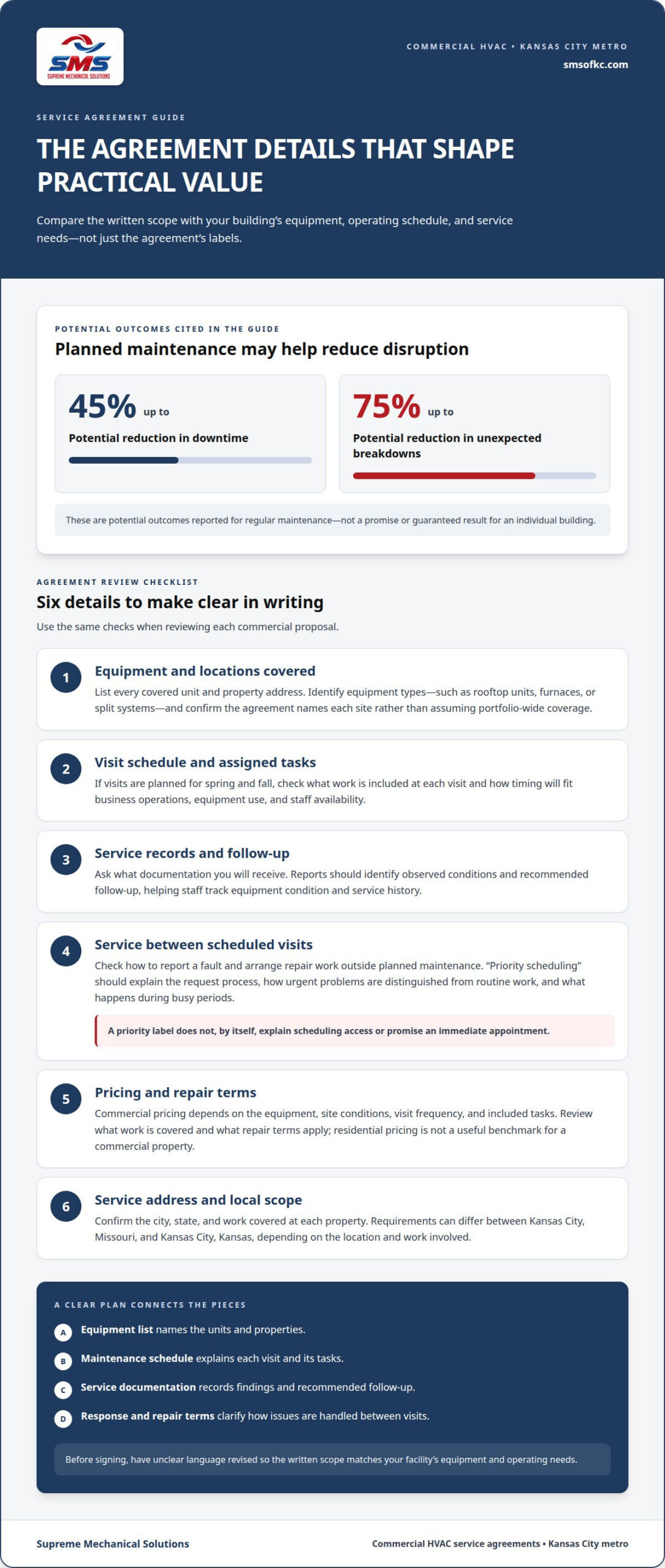
Commercial preventive maintenance is useful when it gives staff a consistent way to track equipment condition and service history. The market figures cited for regular maintenance under commercial HVAC service agreements suggest potential reductions of up to 45% in downtime and up to 75% in unexpected breakdowns. These are potential outcomes, not a promise for an individual building.
Without planned maintenance, developing problems may go unnoticed until they affect operations. An unclear agreement can also leave uncertainty about which units are serviced and what technicians record. Check that reports identify observed conditions and recommended follow-up. Specific records help facility teams make informed decisions rather than relying on memory.
Agreement Pricing and Evaluation
Residential maintenance pricing is not a useful benchmark for commercial properties. Commercial scope varies with equipment, site conditions, visit frequency, and included tasks. Pricing depends on the specific requirements and is provided after a quote request.
To evaluate an agreement, list the covered units and sites, scheduled tasks, documentation, and repair terms. Have unclear language revised before signing. Requirements can differ between Kansas City, Missouri, and Kansas City, Kansas, depending on the location and work involved. Make sure the agreement clearly states the service address and scope.
Kansas City service area and technician experience
Confirm that a commercial agreement covers your property’s location and equipment. Kansas City businesses should also consider whether the contractor’s commercial services fit their systems and operating demands.
Kansas City Service Coverage
Commercial HVAC contractors serve properties across the Kansas City metro in Kansas and Missouri, but coverage varies. Specify the facility’s city and state when comparing agreements. A restaurant in Kansas and a warehouse in Missouri may need different schedules, even within the same metro area.
Check how the agreement handles service at every property it covers. For multiple sites, list each address and the equipment at that location. Confirm that the written scope identifies those locations, rather than assuming one agreement automatically applies across a portfolio. Businesses comparing local coverage can review the Kansas City metro service area as one practical reference.
Which HVAC contractors offer commercial service agreements in Kansas City? Commercial HVAC contractors in the metro offer agreements with varying service areas and scopes. Compare locations covered, equipment included, scheduled tasks, and repair terms.
Technician Experience and Contractor Options
Technician experience is most relevant when it matches the equipment at your site. Rooftop units have different service needs from split systems, furnaces, or heat pumps. Check how the agreement identifies equipment and records maintenance findings. Clear records help staff track recurring issues and plan repairs.
Compare contractor proposals using practical criteria. Review each agreement for:
- The commercial equipment types included, such as rooftop units or split systems.
- The maintenance tasks assigned to each visit and the records provided afterward.
- The process for reporting a fault and arranging repair work outside scheduled maintenance.
- The properties and equipment locations named in the agreement.
These details distinguish a contract designed for commercial operations from one with broad, unclear coverage. A restaurant manager, for example, may need separate rooftop equipment identified across multiple dining locations. A property manager may prioritize records tied to each building and unit.
Use the same checklist for every proposal and note differences in scope. Fewer scheduled visits may leave more work outside the plan, while a longer equipment list calls for clear site-by-site records. Match the terms to your operating schedule and the systems that support daily business. Written clarity makes maintenance coordination and repair response easier.
Priority scheduling and multi-unit discounts
Priority scheduling and multi-unit terms can affect an agreement’s practical value. Read the written conditions carefully: labels alone do not explain scheduling access or discounts.
“Priority scheduling” should describe a process, not promise an immediate appointment. Look for how requests are handled, how urgent equipment problems are distinguished from routine work, and how scheduling is communicated. The agreement should say whether priority applies to service calls, planned maintenance, or both, and explain what happens during busy periods when several customers need service.
A restaurant may need faster attention for a failed dining-area unit than for equipment serving a seldom-used space. Ask how service requests are categorized and who at your business should report an issue. Clear reporting procedures help staff provide the address, affected equipment, operational impact, and access details, giving the service team useful context for arranging a visit.
Multi-unit discounts depend on the agreement’s written terms. Do not assume that covering several units automatically lowers the total or gives every unit the same maintenance. A proposal may group equipment at one property or cover units at multiple sites. Compare the scope and charges for each arrangement, then weigh the total against the included work.
Commercial HVAC service agreement pricing depends on equipment type and condition, the number of units and sites, visit frequency, included tasks, access needs, and repair terms. Pricing depends on the specific requirements and is provided after a quote request. A useful proposal connects these factors to a clearly defined scope instead of giving a figure without explaining what it covers.
Before accepting a multi-unit offer, map each unit to its location and maintenance tasks. A property with rooftop equipment and separate split systems, for example, needs a scope that identifies both. Check whether any discount applies to all covered equipment, scheduled maintenance only, or another defined portion. Compare equivalent scopes rather than headline savings.
- Match every listed unit to a building, system type, and covered task.
- Separate routine visits from repair work and related charges.
- Check how priority scheduling is defined and how requests are handled.
- Compare multi-site terms with a single-property agreement using the same scope.
These steps make the trade-offs easier to see. Broader equipment coverage may suit a multi-building operator, while a smaller facility may prefer a focused scope. Choose terms that fit your equipment, operating needs, and service coordination process.
Annual HVAC tune-ups
An annual maintenance visit gives facility staff a planned opportunity to review HVAC condition and needs. Its value depends on which equipment is covered, what tasks are performed, and whether findings lead to documented follow-up. For a Kansas City warehouse, the agreement should identify each covered unit and link service notes to that equipment.
Start with the written task list. Commercial systems may include rooftop units, split systems, mini-split systems, and VRF equipment, each with different service considerations. Useful records identify the unit, work completed, observed condition, and recommended next step. Compare those records with the agreement to ensure the visit has a defined scope, not just a general “tune-up” label.
Filters and coils deserve specific attention in the maintenance plan. According to the U.S. Environmental Protection Agency, a missing filter can lead to plugged coils, reduced HVAC effectiveness, poor indoor air quality, and substantial component repair or replacement costs. Check that the agreement identifies filter service and coil cleaning where applicable. For example, a facility manager can compare the service report with the equipment list after each visit.
Include belts in the inspection discussion when the equipment uses them. Check whether the agreement distinguishes inspection from replacement and explains how technicians record wear or other findings. This helps managers plan follow-up instead of assuming repairs are part of routine maintenance. A note tied to a specific unit is more useful than a general building-wide report.
Tracking faults matters in daily operations. The National Institute of Standards and Technology (NIST) states that faults in commercial HVAC systems can waste significant amounts of energy during daily operation. Maintenance records can help staff identify recurring issues, such as repeated findings on a rooftop unit. Reports should state what was observed and what action was recommended.
Use each annual visit to update the building’s equipment records. Confirm that unit labels match the agreement, note access limits, and file findings under the correct property. If equipment or operating needs change, update the maintenance scope so future visits reflect the site as it is now.
- Match each covered unit to its location and system type.
- Review whether filters, coils, and belts appear in the task scope.
- Separate routine maintenance findings from repair recommendations.
- Keep visit records tied to equipment for comparison over time.
A maintenance visit is most useful when it produces clear, equipment-specific records. Compare the agreement’s task list with the systems at your site, then use each report to track findings and plan any follow-up maintenance or repair.
HVAC service contract inclusions
A clear agreement defines covered equipment, planned tasks, records, and service-call support. Emergency response times and after-hours service are not automatically part of routine maintenance. The contract should state whether they are included and how urgent requests are handled.
Included Contract Services
A commercial HVAC service contract may include routine maintenance, system inspections, refrigerant-related work and documentation, and technician support. Compare its task list with the equipment schedule so each covered rooftop unit, split system, or other system has a defined scope.
Check how the contractor records inspection findings, refrigerant work, and recommended repairs. A report tied to a specific unit, for example, helps staff track recurring issues and plan follow-up.
Emergency and After-Hours Coverage
Look for separate terms for urgent calls, after-hours requests, and response expectations. The agreement should explain how to report a problem, what information the caller should provide, and how the contractor will communicate next steps.
Ask whether emergency work is included or handled separately. A failed rooftop unit affecting business operations may require a different process from a routine maintenance finding. Clear terms help managers understand the difference before a disruption occurs.
Read exclusions alongside the included tasks. A contract may cover inspection and maintenance while treating corrective repairs as separate work. It should distinguish those activities and explain how a technician’s findings lead to a repair decision. This helps staff avoid assuming every recommended fix is covered.
For a property with multiple units, match the agreement’s equipment list to the site. Confirm that it identifies unit locations, system types, and tasks for each visit. If refrigerant-related work is included, check how it and its documentation appear in service records. These details give facility teams a usable account of each visit.
Before signing, compare the agreement with the questions your operating team needs answered:
- Which equipment and locations are covered?
- What maintenance and inspection tasks are included?
- How are findings, refrigerant work, and repair recommendations documented?
- How are emergency calls, after-hours requests, and separate repairs handled?
Use the written answers to judge the agreement’s actual scope, not just its title. Clear inclusions and exclusions help managers coordinate service, track maintenance, and understand what happens when a system needs attention.
Supreme Mechanical Solutions: Air Conditioning
Supreme Mechanical Solutions provides commercial air conditioning services for businesses in the Kansas City area, including rooftop units, split systems, mini-split systems, and VRF systems. If maintenance findings point to recurring cooling concerns or your team needs to coordinate planned work, discuss your facility’s needs with the team.
Bring your operating priorities and relevant maintenance findings to Supreme Mechanical Solutions. The team can discuss a suitable next step for your commercial property. Reach out to start the conversation.
Put your maintenance plan to work
Use your next contract review to connect maintenance decisions with your facility’s operating priorities. Identify the systems most critical to daily work, who coordinates service, and how staff will use maintenance records when planning repairs. This gives your team a practical framework for managing HVAC needs throughout the year.
For a commercial HVAC service agreement in Kansas City, choose terms that fit your property and equipment rather than relying on a generic scope. Supreme Mechanical Solutions provides commercial air conditioning for rooftop units, split systems, mini-split systems, and VRF systems. Your on-site equipment is a clear starting point for discussing service needs.
A focused conversation can help you decide what your building needs next, whether you are reviewing current coverage or arranging HVAC service. Share your equipment details and priorities with Supreme Mechanical Solutions to discuss a plan for your operation.
Clear planning helps your team manage the systems your business depends on.
Frequently Asked Questions
What does a commercial HVAC service agreement typically include?
An agreement can also explain how service visits fit into daily operations. A restaurant may need technicians to coordinate access around opening preparations, while a property manager may need advance notice for tenant spaces. Identify the site contact, access procedure, and preferred work windows. These details help staff coordinate visits while minimizing disruption to normal building activity.
What are typical commercial HVAC preventive maintenance schedules?
Commercial maintenance schedules may use annual, seasonal, or quarterly visits, depending on equipment use and site operations. Plan around staff availability and times when equipment can be inspected with minimal disruption. A warehouse manager, for example, can coordinate maintenance with planned facility activity. Record completed visits on the property’s maintenance calendar to reduce scheduling conflicts.
What should businesses compare when choosing a Kansas City HVAC service contract?
Compare how agreements handle administration, including renewal timing, billing structure, reporting format, and updates to the equipment list. If several managers are involved, identify who receives service notices and who can approve work. These terms affect how smoothly the agreement fits internal procedures. A consistent review process also makes future proposals easier to compare.
What should a commercial HVAC service agreement say about repairs, parts, and exclusions?
The agreement should clarify approvals before additional work begins. Name the person authorized to approve repairs, explain how estimates are presented, and state whether approval can be given by phone or must be in writing. A facility manager, for example, can establish an internal approval contact before a technician identifies a repair need. Clear steps help staff act without confusion.
Which HVAC contractors offer commercial service agreements in Kansas City?
Commercial HVAC contractors serving the Kansas City metro offer service agreements, but coverage and scope vary. Compare service locations, covered equipment, scheduled work, and repair terms.


