
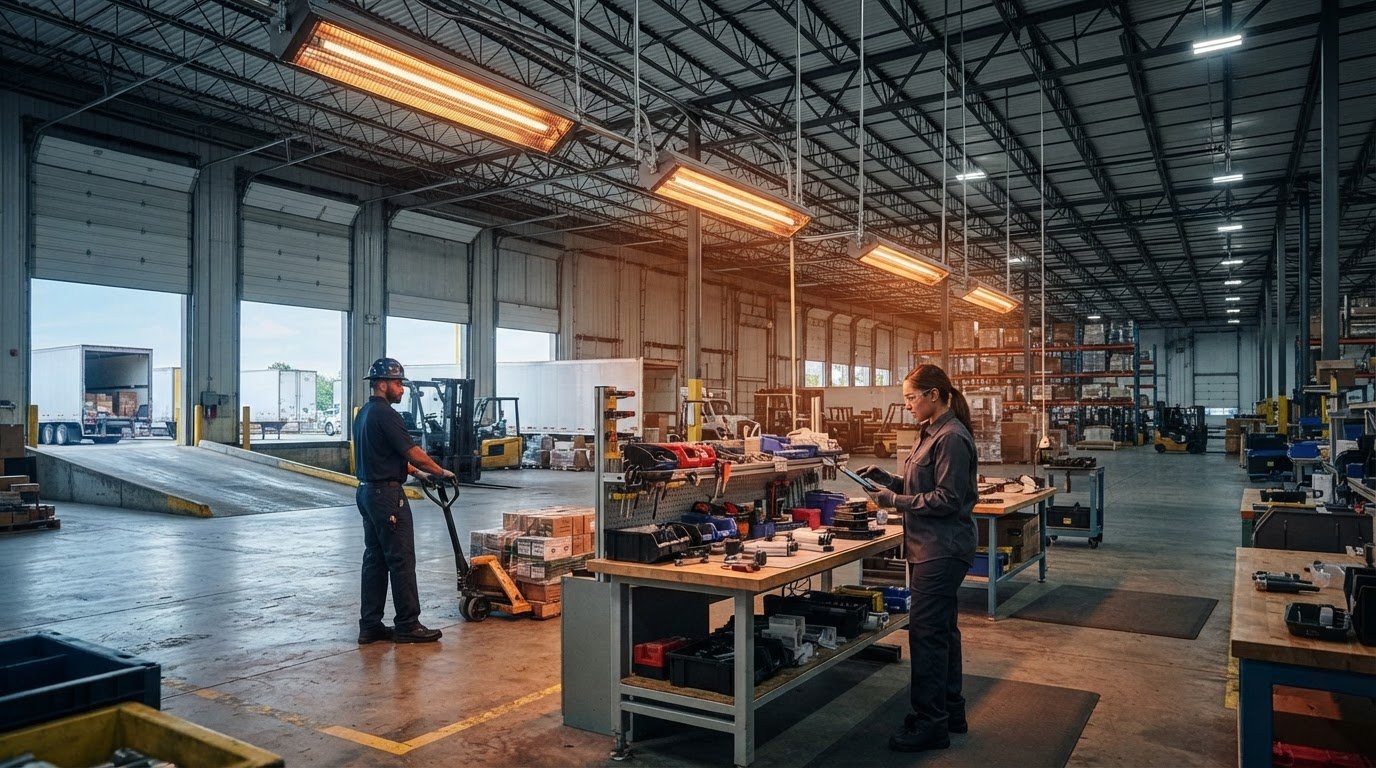
What if the coldest part of your building isn’t a problem the whole heating system needs to solve? Uneven comfort around workstations, loading areas, or occupied zones can make commercial infrared heating worth considering. Unlike forced-air equipment, infrared heaters transfer heat to people and surfaces in their path rather than relying primarily on warmed air moving through the space.
That difference can be useful, but it doesn’t make infrared the right fit for every commercial building. The layout, ceiling height, door use, work activity, and specific areas that need heat all matter. A system should match how your facility operates, not just the temperature you want to reach.
This guide explains the basic operating principle, where infrared heating may suit businesses such as warehouses, restaurants, and gas stations, and where a closer facility assessment is needed. You’ll also learn what building and operating details to gather before discussing a heating project. Supreme Mechanical Solutions provides commercial heating services, including infrared heaters, across the Kansas City metro in Kansas and Missouri, along with related HVAC, refrigeration, and kitchen equipment support.
Key Takeaways
- Assess commercial infrared heating by matching the heater’s coverage to the areas your team occupies and the work being done there.
- Compare the heating objective with the space involved to determine whether targeted warmth or building-wide heating is the better fit.
- Before planning a project, document operating schedules, work areas, building layout, and existing heating equipment.
- Supreme Mechanical Solutions supports commercial facilities with infrared heaters and related HVAC, refrigeration, and kitchen equipment services.
What Is Commercial Infrared Heating, and What Does It Warm?
Commercial infrared heating uses radiant energy to warm people and surfaces the heat reaches, rather than relying primarily on circulating warmed air to heat a space. That difference describes how heat is transferred, not a guarantee that every part of a building will feel the same. Room conditions, heater placement, the area being served, and the building’s existing heating system all influence comfort.
Think of sunlight reaching a workstation through a window. The light warms surfaces and people it falls on, while the surrounding air is not warmed in the same way as it would be by a system designed to heat and circulate indoor air. An infrared heater works through a related radiant principle. A basic overview of an infrared heater explains how the equipment produces radiant heat.
How radiant heat differs from air-based heating
Air-based commercial HVAC equipment primarily heats indoor air and distributes it through the space. Infrared heating instead directs radiant energy toward surfaces and people within its coverage. For example, a worker at a designated packing station may receive radiant warmth while nearby equipment or the floor also absorbs heat. Areas outside that coverage may experience different conditions.
This distinction matters when assessing comfort. Infrared heating doesn’t automatically remove drafts, create even temperatures, or replace the need to heat the rest of a building. Air movement, obstructions, the location of occupied areas, and how the system is designed all affect the result. The practical question is what needs heat, and where.
Where commercial infrared heating may be considered
Businesses may assess infrared for a defined work zone where people spend time and localized warmth is the goal. In a warehouse, that might mean an occupied work area rather than every aisle or the full building. A service or assembly station, a receiving area, or another frequently used zone could also prompt an assessment. These are examples to evaluate, not a promise of fit.
For Kansas City metro businesses, the building’s use and layout should guide the discussion. Consider where employees work, how the space is arranged, whether partitions or stored materials interrupt the heater’s coverage, and whether broader heating is also required. A restaurant, gas station, or warehouse may have distinct occupied zones and operating patterns, so the same approach won’t suit every facility.
Commercial infrared heating is one option among commercial heating approaches. Supreme Mechanical Solutions provides commercial heating services, including infrared heaters, for businesses in the Kansas City area. Operators comparing heating needs can review the company’s commercial heating services as part of planning for their facility. The next step is to examine how radiant heat moves through an occupied space and how positioning affects coverage.
How Commercial Infrared Heating Works in an Occupied Space
To understand how commercial infrared heating affects comfort, follow the heat from its source to the people and surfaces in the work area. The general process is straightforward, but the amount of warmth occupants perceive depends on the equipment, its placement, and the space around it.
From heater output to perceived warmth
An infrared heater sends radiant energy toward people and surfaces in its coverage, where that energy is absorbed and experienced as warmth. Unlike a system that primarily heats indoor air and moves it through a building, radiant heat can reach an exposed work surface or an occupant directly. Nearby objects may also absorb heat and then contribute to how the space feels.
Picture an employee working at a fixed station beneath or in front of a heater. The worker, equipment, and other exposed surfaces may receive radiant energy. The room air is still part of the overall environment, but warming and circulating that air isn’t the primary transfer method. The example describes the principle, not a guarantee that a particular station will reach a specific temperature.
Equipment-specific details depend on system design. Heater output, operating method, and intended application can differ, so the general explanation shouldn’t be treated as a product specification. Facility decisions need to account for the actual equipment and the conditions where it will operate.
Why placement and line of exposure matter
Radiant energy needs a path to the intended area. Shelving, stored materials, partitions, machinery, and other obstructions can intercept energy before it reaches an occupant or surface. A workstation that is open to the heater may have a different exposure from one positioned behind a tall rack or around a corner.
That makes the occupied-area layout central to planning. In a warehouse, for example, work may happen at a receiving station, a packing area, or a fixed equipment position. Mapping those locations helps distinguish areas that need targeted warmth from aisles or storage zones with little regular occupancy. The arrangement of doors and partitions can also shape how the space is used, but it doesn’t establish a heater’s performance on its own.
Ceiling height and mounting context belong in a site-specific assessment. A heater’s position relative to occupied work areas affects where its radiant energy can reach; building dimensions and obstructions influence that relationship. There isn’t one mounting position that applies to every facility, so avoid assuming that a placement suitable in one building will suit another.
For a useful assessment, document where people work, what may block exposure, and how the space is arranged during operating hours. Supreme Mechanical Solutions provides commercial heating services, including infrared heaters, for Kansas City-area businesses. If you’re reviewing equipment options alongside site conditions, explore the company’s commercial heating services.
When Is Commercial Infrared Heating a Better Fit Than Other Options?
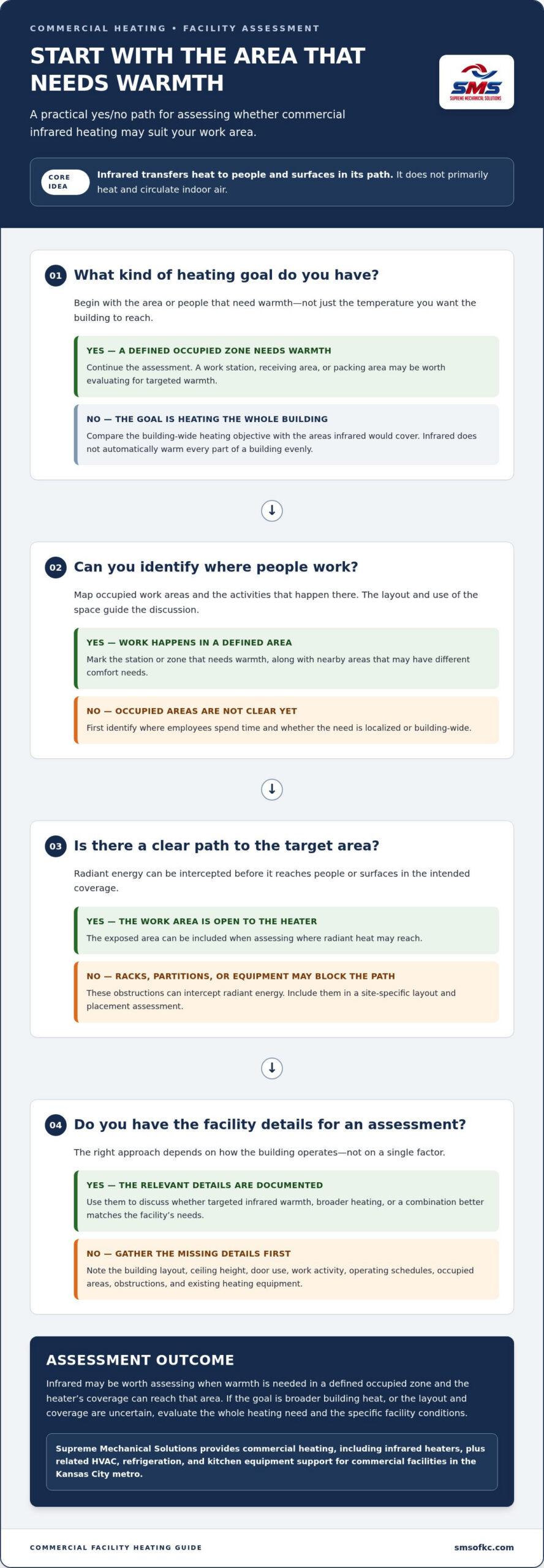
The right heating approach depends on what the facility needs to warm. Commercial infrared heating may suit a defined occupied area, while a furnace, heat pump, unit heater, or rooftop system may be considered for broader building needs. Infrared isn’t automatically a replacement for whole-building HVAC. A facility can assess it alongside its existing heating approach, with the goal of matching equipment to the space and operation.
Targeted heating versus whole-building heating
Start with the heating objective. Is the concern comfort at a particular work area, or does the facility need heat distributed across multiple rooms or a larger open space? A targeted zone and a building-wide need are different problems, even if both involve uneven comfort.
Use this comparison to frame the assessment. It’s a starting point, not a substitute for reviewing the building’s layout, existing equipment, and operating needs.
Heating objective: Warm a defined work or occupied zone. Approach to assess: Infrared may be considered where people regularly occupy an identifiable area.
Occupied area: Address comfort in spaces with distinct work areas or intermittent use. Approach to assess: Consider infrared alongside existing HVAC, accounting for where people spend time and how the facility operates.
Building-wide needs: Provide heating across a larger portion of the facility. Approach to assess: Evaluate systems such as furnaces, heat pumps, unit heaters, or rooftop units in relation to the building and its use.
Infrared heating alongside other commercial systems
Each system type serves a different role. Infrared transfers heat to people and surfaces it reaches. Furnaces and heat pumps are other commercial heating options, while unit heaters and rooftop units may be part of a facility’s broader heating setup. These categories alone don’t determine which system will best address a specific building’s needs.
A business with existing HVAC might assess infrared for a localized comfort concern without assuming the primary system should be removed or replaced. If the issue spans occupied areas throughout the facility, a targeted heater may not address the full objective. Review how the space is used, which areas need heat, and what equipment already serves them.
For example, a manager may identify one consistently occupied service area that feels different from the rest of the facility. That calls for a different evaluation than a building-wide heating concern across offices, work zones, and shared spaces. In either case, compare the intended coverage with the actual need rather than assuming one heating method is superior.
Use the comparison as a starting point, then consider the facility’s heating needs as a whole. A practical plan accounts for both occupied areas and broader building requirements, and may include infrared alongside other commercial heating equipment.
How to Assess Infrared Heating for a Kansas City-Area Facility
A useful assessment starts with the facility’s actual heating concern, not a decision about equipment. For Kansas and Missouri commercial buildings, document how the space operates and where comfort is lacking. That gives a heating discussion practical context, whether you’re considering commercial infrared heating or reviewing the broader system.
Define the heating problem before selecting equipment
Work through these steps in order:
- Describe the issue. Identify the area where comfort is a concern and whether it affects one work zone or multiple parts of the building. Note what staff or customers experience, and when the issue occurs.
- Map occupied zones. Mark workstations, service areas, receiving or loading areas, and other locations where people spend time. Record whether those areas are occupied continuously or at set times.
- Review building conditions. Note the ceiling height, room or open-area layout, partitions, doors, and fixed equipment. Include obstructions that could affect how heat reaches an occupied area.
- Document existing equipment. Record the type and location of current heating equipment, which areas it serves, and how the facility uses it. Note operational constraints, such as work areas that can’t be blocked or schedules that limit access.
These details help distinguish a localized comfort concern from a broader building-heating issue. For instance, if reports consistently point to one occupied area, record that pattern and the conditions there. If multiple areas are affected, include each one rather than treating the building as a single zone.
Prepare useful facility information
A simple floor plan is a practical starting point. Mark occupied work areas, doors, partitions, equipment, and the locations of existing heaters or other heating equipment. Add ceiling information where available, and note changes in layout that affect how people use the space. The goal is to make the facility’s conditions easier to discuss, not to develop an equipment design yourself.
Operating schedules matter, too. Record typical hours, shifts, periods of intermittent use, and when the comfort issue is most noticeable. A manager of a restaurant, gas station, warehouse, or other commercial building can also note whether work moves between zones or stays concentrated in one area. Keep observations specific: which area, what time, and what activity was taking place.
For Kansas City-area facilities, these observations provide a grounded basis for reviewing heating needs without assuming that every building has the same conditions. Supreme Mechanical Solutions offers commercial heating options that include infrared heaters, furnaces, heat pumps, unit heaters, and rooftop units. Reviewing its commercial heating services alongside your facility notes can help frame a project discussion around the space and its operation.
Bring the notes together before evaluating next steps. A clear description of the issue, an occupied-zone map, operating schedules, and existing equipment details give the assessment a practical starting point.
Commercial Infrared Heating Support from Supreme Mechanical Solutions
Partnering with experienced professionals ensures your business gets the most efficient, reliable heating system tailored to your facility’s specific layout and operational demands. Supreme Mechanical Solutions provides comprehensive expertise in commercial infrared heating, guiding you from initial system selection through expert installation, preventative maintenance, and prompt repair services to keep your workspace comfortable year-round.
Move Your Heating Project Forward
A considered plan is a solid starting point for moving your heating project forward.
Frequently Asked Questions
Does commercial infrared heating replace a building’s existing HVAC system?
No. Infrared heating is an approach to heat transfer, not an automatic substitute for a building-wide system. It may be considered for a specific occupied area, while broader heating requirements can call for a different or complementary approach. Before treating any equipment as a replacement, assess the facility as a whole, including how the space is used, which areas need heat, and what the existing system serves.
Can commercial infrared heating be used alongside existing heating equipment?
Yes, a facility can evaluate infrared as part of a wider heating plan, including when one occupied zone has a different comfort need. For example, a fixed work area may have different heating priorities from nearby offices or storage space. Don’t assume compatibility or a particular result without assessing the building. The existing equipment, layout, and intended use all shape how the options should be considered.
How much electricity does a commercial infrared heater use?
Electricity use depends on the heater’s rated electrical input and its actual operating time. To estimate consumption, use the equipment’s rated input, convert it to kilowatts if needed, and multiply by the hours it runs. That gives an estimate of energy use, not a savings projection or a complete utility bill calculation. For a specific facility, use the selected equipment’s actual rating and operating records.
Does commercial infrared heating warm the air or the people in a space?
Infrared transfers radiant heat to exposed people and surfaces rather than relying primarily on warming and circulating all indoor air. For instance, an employee and nearby work surfaces within the heater’s coverage can receive radiant energy. The surrounding air can still be affected as surfaces warm and through normal building conditions. Air temperature remains relevant to overall comfort, so consider both the occupied area and the facility’s broader heating needs.
What information should a facility manager gather before discussing infrared heating?
Record the areas with comfort concerns, who uses them, and when those areas are occupied. Note operating hours, the building layout, existing heating equipment, and conditions such as doors, partitions, or stored materials that affect the space. A floor plan marked with work areas and equipment locations can help explain the situation. These notes frame the heating objective, but they don’t determine equipment specifications on their own.
Is commercial infrared heating suitable for every warehouse or restaurant?
No. Suitability depends on the specific operation, occupied zones, layout, and heating objective, not just the building type. A warehouse and a restaurant can have different schedules, work patterns, and comfort needs. Supreme Mechanical Solutions serves commercial facilities in Kansas City, Kansas City, MO, Kansas City, KS, Overland Park, Olathe, Lenexa, Shawnee, Leawood, Lee’s Summit, Independence, Blue Springs, Liberty, Gladstone, Grandview, Belton, Raymore, and Louisburg. Assess the particular space and its existing heating approach.


